

The Wu-Tang Clan's Once Upon a Time in Shaolin
(2014)
The Wu-Tang Box was commissioned by the legendary hip-hop collective Wu-Tang Clan, in collaboration with their producer Cilvaringz, to house their singular album Once Upon a Time in Shaolin. Conceived as both an artwork and a cultural statement, the project was a direct response to the erosion of value in recorded music in the digital age. Rather than releasing the album commercially, the group chose to treat it as a unique artwork, producing only one copy and presenting it through a meticulously crafted object. The box became an integral part of the work’s conceptual framework, reinforcing the idea of music as a rare, ceremonial artefact rather than a mass-distributed product.
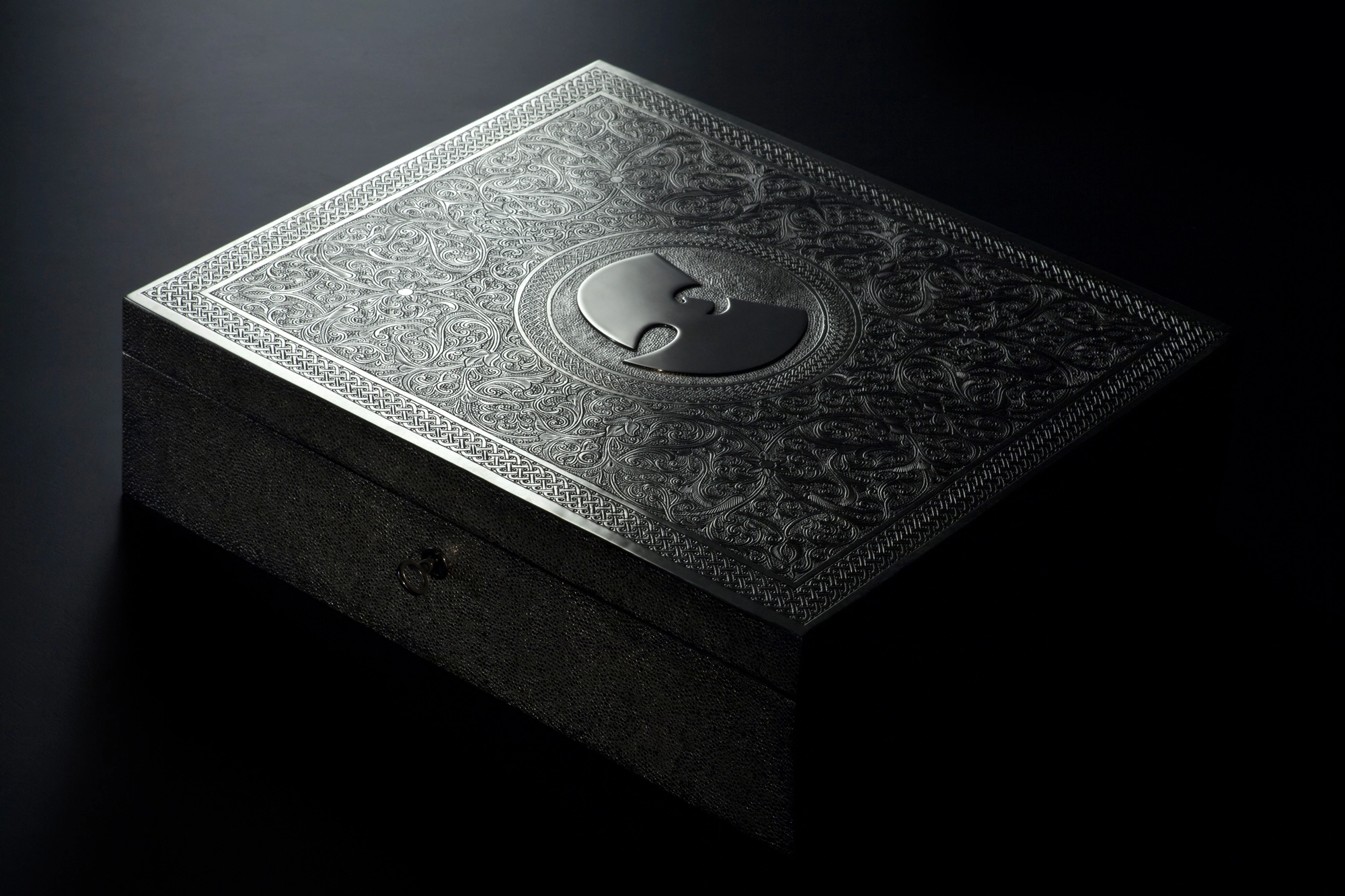
The outer box is executed in nickel silver, with the iconic Wu-Tang “W” logo positioned at its centre and surrounded by intricate floral motifs, all hand-engraved directly into the metal. Within this lies a second box, again bearing the Wu logo, whose surface is formed through a combination of hand-sawn metal elements and engraved floral detailing. This inner structure houses the CD container itself, continuing the same language of ornament and symbolism. The sequence culminates in a further enclosing leather box, also marked with the Wu-Tang emblem, creating a deliberate progression of materials, textures, and symbolic layers—a box within a box within a box—each crafted to elevate the act of access into a ritual.
Upon its unveiling and subsequent auction, the Wu-Tang Box became a global cultural phenomenon, widely covered by major international media, including Forbes. The album was eventually purchased by Martin Shkreli, whose public conflict with the group, damage to the box, and threats to release the music intensified its notoriety. Following Shkreli’s conviction, the U.S. government seized the album and the box, later auctioning them to the crypto-art collective PleasrDAO, who now hold the work. The object’s journey—spanning legal seizure, cultural controversy, and renewed relevance within digital culture—has since been documented in film, cementing the Wu-Tang Box as a landmark intersection of art, music, protest, and authorship.


Photography Credit: Warren Wesley Patterson - Emilio Rouach
The Wu-Tang Clan's Once Upon a Time in Shaolin
(2014)
The Wu-Tang Box was commissioned by the legendary hip-hop collective Wu-Tang Clan, in collaboration with their producer Cilvaringz, to house their singular album Once Upon a Time in Shaolin. Conceived as both an artwork and a cultural statement, the project was a direct response to the erosion of value in recorded music in the digital age. Rather than releasing the album commercially, the group chose to treat it as a unique artwork, producing only one copy and presenting it through a meticulously crafted object. The box became an integral part of the work’s conceptual framework, reinforcing the idea of music as a rare, ceremonial artefact rather than a mass-distributed product.
The outer box is executed in nickel silver, with the iconic Wu-Tang “W” logo positioned at its centre and surrounded by intricate floral motifs, all hand-engraved directly into the metal. Within this lies a second box, again bearing the Wu logo, whose surface is formed through a combination of hand-sawn metal elements and engraved floral detailing. This inner structure houses the CD container itself, continuing the same language of ornament and symbolism. The sequence culminates in a further enclosing leather box, also marked with the Wu-Tang emblem, creating a deliberate progression of materials, textures, and symbolic layers—a box within a box within a box—each crafted to elevate the act of access into a ritual.
Upon its unveiling and subsequent auction, the Wu-Tang Box became a global cultural phenomenon, widely covered by major international media, including Forbes. The album was eventually purchased by Martin Shkreli, whose public conflict with the group, damage to the box, and threats to release the music intensified its notoriety. Following Shkreli’s conviction, the U.S. government seized the album and the box, later auctioning them to the crypto-art collective PleasrDAO, who now hold the work. The object’s journey—spanning legal seizure, cultural controversy, and renewed relevance within digital culture—has since been documented in film, cementing the Wu-Tang Box as a landmark intersection of art, music, protest, and authorship.